




AI Agents in 2026: How Businesses Can Automate Workflows and Reduce Manual Tasks
Beyond Chatbots: How Agentic AI Is Transforming Business Operations in 2026 Artificial Intelligence is moving beyond answering questions and genera...
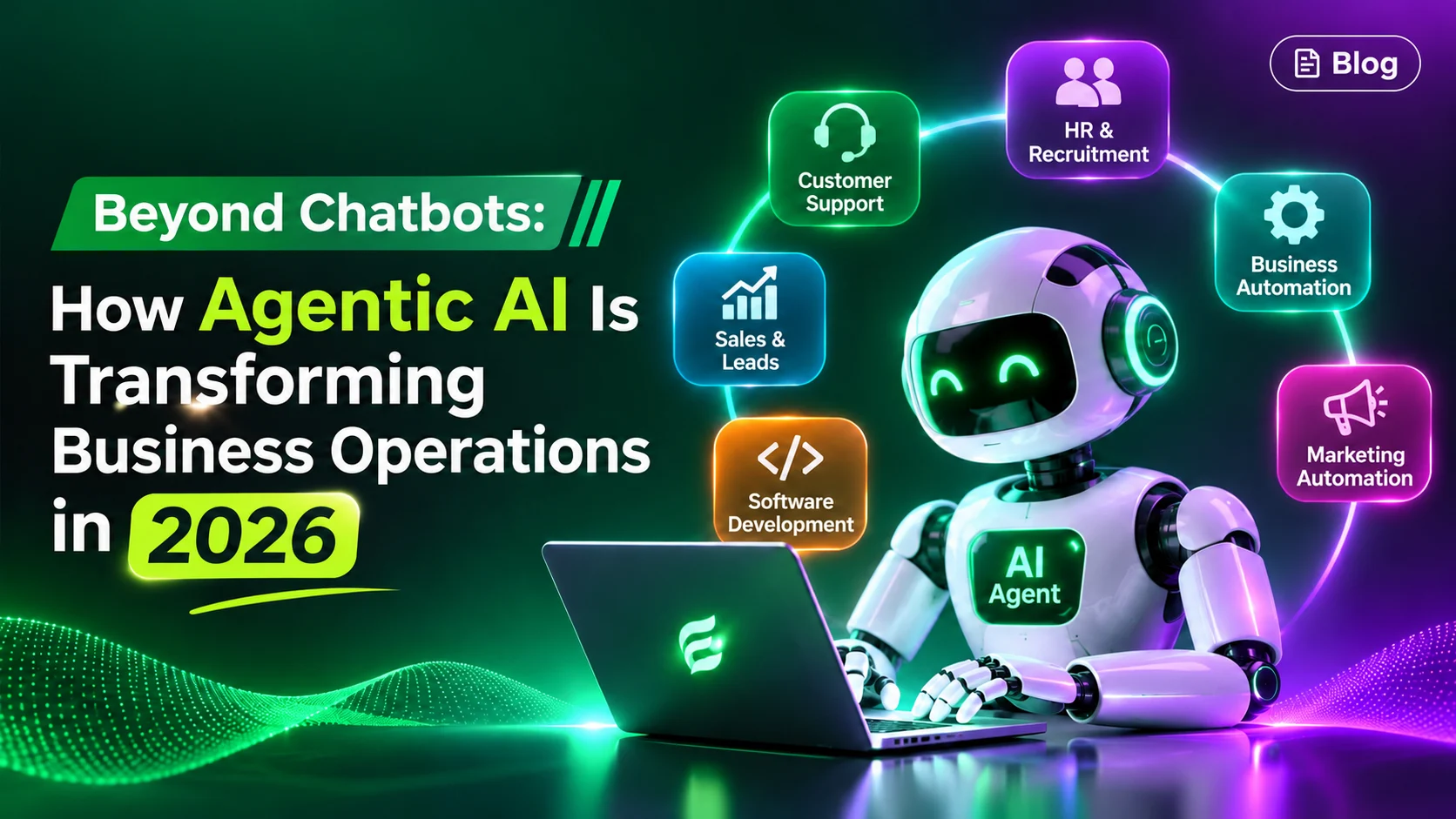
Beyond Chatbots: How Agentic AI Is Transforming Business Operations in 2026
Artificial Intelligence is moving beyond answering questions and generating content. In 2026, businesses are increasingly exploring a new generation of AI technology known as Agentic AI.
Unlike traditional chatbots that mainly respond to user instructions, AI agents can understand goals, plan tasks, use connected tools, and execute multi-step workflows with appropriate permissions and human supervision.
From customer support and sales management to software development and business operations, Agentic AI is creating new opportunities for organizations to improve productivity and deliver better customer experiences.
1. What Is Agentic AI?
Agentic AI refers to AI systems designed to work toward specific objectives by planning and executing multiple steps.
A traditional chatbot might answer a customer's question about an order. An AI agent could potentially check the order status, identify a delivery delay, create a support ticket, notify the customer, and escalate the issue when necessary.
The key difference is that an AI agent can move beyond providing information and take actions through connected systems.
2. How Does Agentic AI Work?
An AI agent typically follows a structured process:
- Understand the Goal: Interpret the user's request or business objective.
- Plan the Tasks: Break the objective into smaller actionable steps.
- Access Information: Retrieve relevant information from databases, documents, or connected applications.
- Execute Actions: Use approved tools, APIs, and business systems to complete tasks.
- Evaluate Results: Check whether the actions achieved the intended outcome.
- Request Human Approval: Seek authorization for sensitive or high-impact actions when required.
3. Top Business Applications of Agentic AI in 2026
AI-Powered Customer Support
AI agents can help businesses handle customer inquiries, retrieve order information, categorize support requests, and create tickets. Complex or sensitive issues can be transferred to human support teams.
Sales and Lead Management
AI agents can assist sales teams by organizing incoming leads, identifying potential customers, preparing follow-up messages, updating CRM records, and reminding sales representatives about pending opportunities.
HR and Recruitment Automation
Organizations can use AI to organize job applications, extract candidate information, compare qualifications with job requirements, schedule interviews, and support recruitment workflows. Human review remains important for employment decisions.
Business Process Automation
AI agents can coordinate repetitive workflows across different business applications, such as invoice processing, document verification, report preparation, and internal task management.
Software Development
AI-powered development agents can assist with code generation, debugging, documentation, test preparation, and code reviews. Developers remain responsible for reviewing and approving production changes.
Marketing Automation
AI agents can help research audiences, generate campaign ideas, prepare content drafts, analyze campaign performance, and recommend improvements.
4. Agentic AI vs Traditional Chatbots
Answer questionsYesYes Understand contextBasic to advancedAdvanced, depending on design Plan multiple stepsLimitedYes Connect to business toolsSometimesYes Execute workflowsLimitedYes, with permissions Evaluate task resultsLimitedCan be designed to do so Human supervisionRecommendedEssential for sensitive actionsAgentic AI does not automatically make every business process fully autonomous. Its capabilities depend on the AI model, connected tools, system design, and permission controls.
5. Benefits of Agentic AI for Businesses
- Improved Productivity: Reduce repetitive manual work.
- Faster Operations: Coordinate multiple workflow steps efficiently.
- Better Customer Experience: Support faster responses and consistent service.
- Operational Efficiency: Reduce unnecessary administrative effort.
- Scalability: Support growing business operations without proportionally increasing manual workloads.
- Better Decision Support: Organize business information and generate useful insights.
The actual benefits depend on the workflow, implementation quality, and how effectively the system is monitored.
6. Challenges Businesses Should Consider
Data Security
AI systems must have controlled access to sensitive company and customer information.
Accuracy
AI-generated decisions and outputs should be validated, especially in financial, legal, and operational workflows.
Integration
Connecting AI agents with existing CRM, ERP, HRM, and accounting systems requires proper API architecture.
Human Oversight
Important actions such as payments, employee decisions, and customer account changes should have suitable approval controls.
Cost Management
AI model usage, infrastructure, integrations, and ongoing maintenance should be considered.
A successful AI implementation requires more than selecting an AI model. It requires a secure and well-designed business solution.
7. How Can Small and Medium Businesses Start Using Agentic AI?
- Identify repetitive tasks that consume employee time.
- Select one workflow with measurable business value.
- Connect the required business applications and data sources.
- Build an AI agent with clearly defined permissions.
- Test the workflow using real-world scenarios.
- Introduce human approval for important actions.
- Monitor accuracy, cost, security, and productivity.
- Expand automation gradually based on results.
For example, a small business could begin with an AI-powered lead management assistant before introducing more complex automation across sales, customer support, and operations.
8. The Future of Agentic AI
Agentic AI is expected to play an increasingly important role in how businesses interact with software and manage operations.
Future business platforms may combine multiple specialized AI agents to support different departments, including sales, marketing, finance, HR, customer service, and software development.
However, successful adoption will depend on responsible implementation, secure integrations, reliable data, and effective human oversight.
Businesses that understand where AI can genuinely improve their operations will be better positioned to benefit from this technology.
9. How Evergreen Infotech Can Help
At Evergreen Infotech, we help businesses explore and implement modern digital technologies that support growth and operational efficiency.
Our technology services include:
- AI Solutions and Automation
- Custom Software Development
- SaaS Product Development
- Web Application Development
- Mobile App Development
- Business Process Automation
- Data Analytics and Business Intelligence
Whether you are planning an AI-powered business application, automating existing workflows, or developing a new SaaS platform, our team can help turn your ideas into practical digital solutions.
Ready to explore AI automation for your business?
Visit Evergreen Infotech to discover our technology services and discuss your next digital project.
Conclusion
Agentic AI represents an important development in the evolution of business automation. By combining intelligent planning, connected tools, and controlled execution, AI agents can help organizations simplify complex workflows and improve productivity.
The opportunity is not simply to use more AI, but to use it strategically to solve real business problems.
Start small, build responsibly, and scale intelligently.